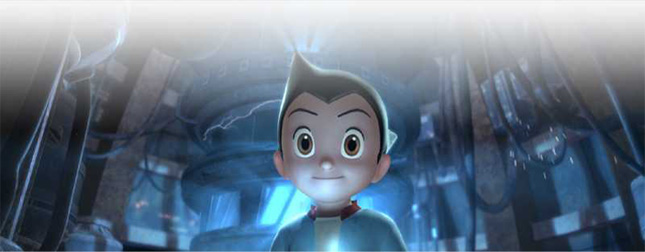
Astro Boy
An Interview with David Bowers
 DAVID BOWERS Starting in the world of animation with Who Framed Roger Rabbit, David Bowers worked at the famed British studio Cosgrove Hall before joining Steven Spielberg's Amblimation in London. When DreamWorks was founded, Bowers relocated to Los Angeles where he worked primarily as a story artist on The Prince of Egypt and The Road to El Dorado. It was during this period that he met Nick Park and Peter Lord, marking the beginning of Bowers' long and fruitful relationship with UK animation house Aardman. Moving between Los Angeles and Bristol (England), Bowers served in key creative capacities on various DreamWorks and Aardman projects including Chicken Run and the Academy Award®-winning Wallace & Gromit: The Curse of the Were-Rabbit, before directing Flushed Away, winner of five Annie Awards.
David Bowers is originally from Stockport, an industrial town near Manchester in the northwest of England. As it is famously cold and rainy, Bowers was more than happy to move to the glorious sunshine and sandy beaches of Southern California – more specifically Hollywood. "I grew up loving films," Bowers said, "so to be living in the heart of cinema history is a real thrill."
It was animation which captivated Bowers from a young age. "I'd always loved animation. Pinocchio was the first film I saw in a cinema and it made a huge impression on me. As a young artist, my work leaned towards caricature and comedy. Animation seemed a perfect fit," he explains.
Bowers continues: "When Who Framed Roger Rabbit came up, I was studying for a degree in animation at the West Surrey College of Art and Design in Farnham, Surrey. I didn't often agree with my tutors and they didn't often agree with me. Roger Rabbit was a dream job. I idolized Robert Zemeckis and Steven Spielberg, not to mention animation director Richard Williams. It was a big-budget, effects-filled movie starring almost all the classic cartoon characters and drawn by some of the greatest animators in the world. I applied for a position as an inbetweener and they accepted me, probably due to desperation as the film was way behind schedule. I think they were hiring just about anyone who could hold a pencil. I gave up my degree and moved to London."
Bowers then worked as an animator / story artist on such films as An American Tail: Fievel Goes West, Balto, The Prince of
Egypt, The Road to El Dorado and Chicken Run. He comments: "I think I've been lucky in that I've had an opportunity to do lots of different jobs. I was an animator for many years, I've done a little layout and was a story artist in the UK before moving to the United States."
After relocating to the U.S., Bowers moved between Los Angeles and Bristol as a key creative contributor on such Aardman / DreamWorks projects as the Oscar®-winning Wallace & Gromit: The Curse of the Were-Rabbit, before directing
Flushed Away.
As to what attracted him to Imagi and to Astro Boy, Bowers says: "I'd been hearing about Imagi and knew that the Astro Boy project was slated for release, so I definitely had an interest. I'd worked with Maryann (Garger) before and she's a great producer, which gave me confidence that Astro Boy could be something very special. Plus I'd seen TMNT and was impressed by the technical prowess and artistry of the crew."
Bowers elaborates on his vision for Astro Boy: "I want Astro Boy to be a really special movie, a mix of action-adventure with lots of comedy and a really emotional story at its core. It's an iconic property and deserves respect, so I don't want to give it the glib, pop-referential treatment that so many animated movies have today. Instead I want it to stand as a classic superhero origin story, something befitting the icon of Astro Boy, kind of along the lines of Richard Donner's Superman. I want it to serve as an introduction to Astro Boy for western audiences whilst remaining faithful to the lore for Asian audiences. Astro Boy is a treasured icon in Japan and so I'm working closely with the Tezuka estate to ensure I get
everything right."
He continues: "Astro Boy is all about finding our identities, and the relationships we have with our parents. On his journey Astro Boy encounters a lot of adversity but manages to overcome it all. It's an optimistic movie."
The director states that he is driven by his passion "to make a great picture that touches people and can be enjoyed by all ages". He adds: "Osamu Tezuka was a visionary, and Astro Boy was new and cutting edge when he created him. The technology and the design have been updated for this movie but the intent and the emotional story are timeless."
The all-star cast is headed by Freddie Highmore, Kristen Bell, Nathan Lane, Eugene Levy, Bill Nighy, Donald Sutherland
and Nicolas Cage as Dr. Tenma. Bowers states: "I just wanted the best actors for the roles that I can possibly get and on Astro Boy I've been very lucky. Our cast balances comedy and drama very well."
Imagi Studios' Astro Boy will be released in theaters across North America on October 23, 2009. Summit Entertainment is distributing worldwide except for Imagi's reserved territories of Japan, Hong Kong and China.
1. What would you say is your normal state of mind when you're directing a movie?
 Focused. There are so many elements to juggle it's important to keep an eye on everything.
2. What is your favorite movie?
La Strada.
3. What technology do you wish could be invented?
Transporter technology from Star Trek would be useful. I'm based in Los Angeles, most of the crew is in Hong Kong and I've recorded actors as far afield as London and Australia. I've got more air miles than I know what to do with.
4. What is your motto?
This is something my grandfather told my father, who in turn told me.
"The man who never made a mistake, never made anything." It's true.